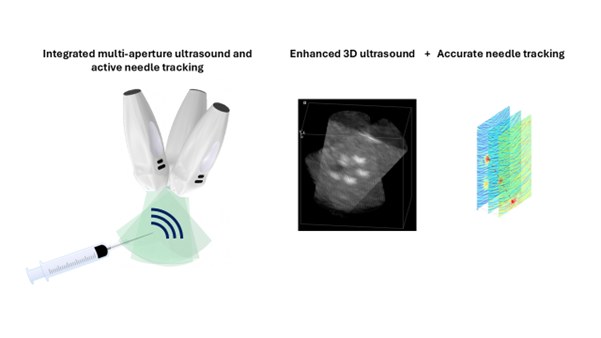

Conventional ultrasound guidance often struggles with poor needle tip visibility, acoustic shadowing, and reduced lesion contrast, especially for deep targets or patients with high BMI, where subcutaneous fat degrades image quality. These limitations increase targeting errors, multiple needle passes, and complication risks.
This project will develop a next-generation guidance system that combines multi-aperture ultrasound imaging, which offers improved penetration, angular coverage, and anatomical visualization, with active needle tip tracking, which provides direct acoustic sensing at the tip for reliable localization. Advanced fusion algorithms will integrate these complementary data streams into a real-time platform designed to improve accuracy, reduce procedure time, and enhance safety.
The research is multidisciplinary, spanning biomedical ultrasound engineering, signal processing, machine learning, and human factors evaluation. The successful candidate will gain expertise in both algorithm development and experimental validation, contributing new methods and prototype technologies with strong potential to transform ultrasound-guided interventions.